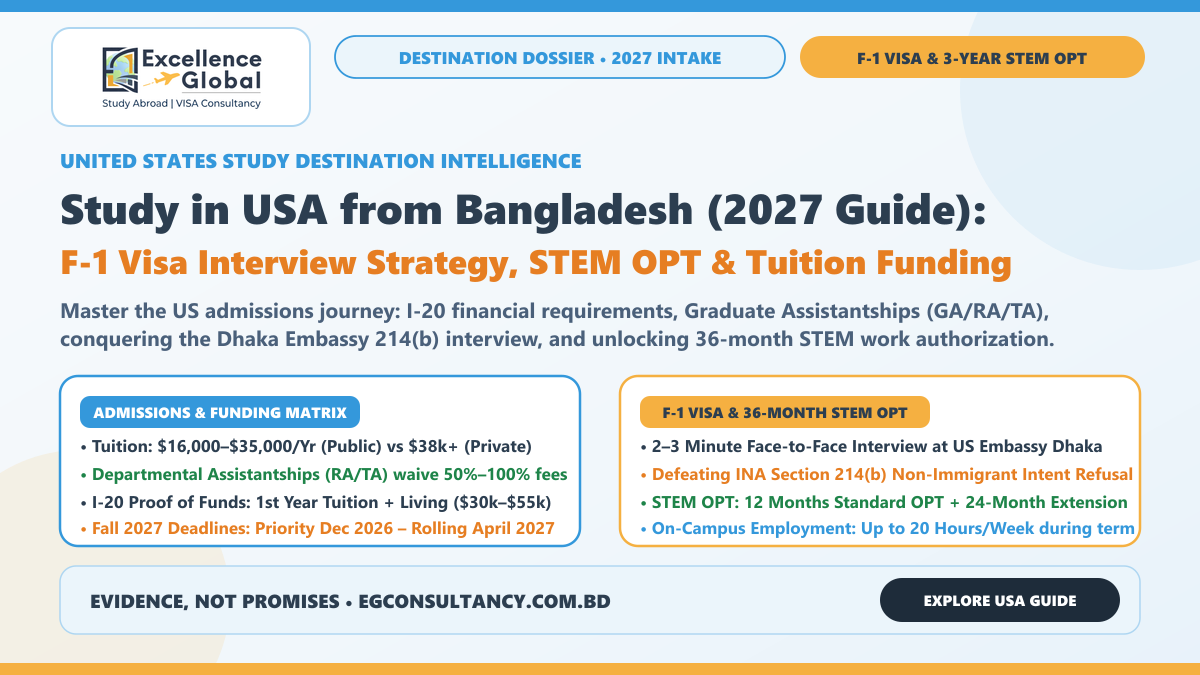
The United States remains the undisputed global gold standard for academic prestige, multi-billion-dollar research infrastructure, and post-graduation career acceleration. For Bangladeshi students, pursuing a degree in the US offers unmatched access to 3-year STEM OPT work rights, highly coveted Graduate Assistantships (GA/RA/TA) that can eliminate 100% of out-of-state tuition, and direct corporate exposure to Fortune 500 innovators. However, navigating the US admissions process requires mastering two distinct, high-stakes milestones: securing university admission with verified Form I-20 funding, and conquering the two-minute in-person F-1 visa interview at the US Embassy in Dhaka under Section 214(b) non-immigrant intent scrutiny. Here is the comprehensive, evidence-first roadmap for studying in the USA from Bangladesh for 2027.
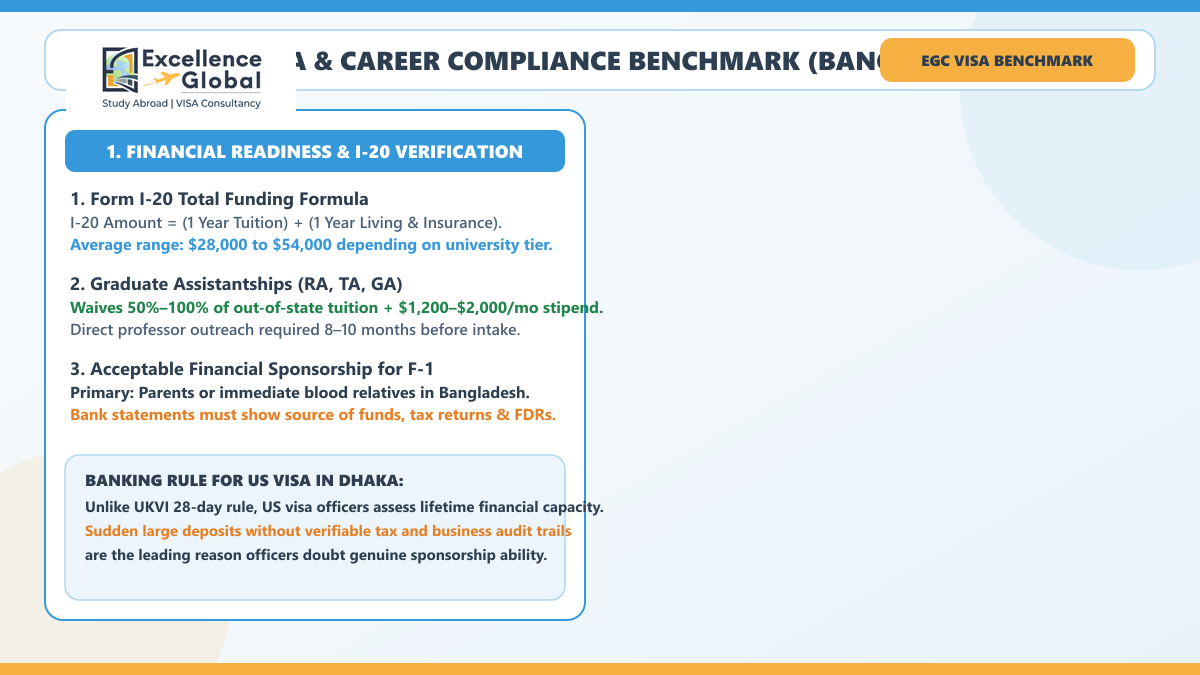
Figure 2: Form I-20 Financial Breakdown, Assistantship Offsets, and F-1 Visa Interview Strategy (2027 Intake).
1. The Sumaiya Rahman Case: Overcoming the 214(b) Refusal Trap
In January 2026, Sumaiya Rahman, a BBA in Finance graduate from North South University (CGPA 3.48), approached Excellence Global Consultancy following a crushing F-1 visa refusal at the US Embassy in Dhaka. Sumaiya held a valid Form I-20 from a private university in New York for an MS in Finance. During her interview, when the consular officer asked, “Why this university and what are your plans after graduation?”, Sumaiya gave a generic, rehearsed answer: “This university has great faculty, and after graduating, I want to work on Wall Street before returning to Bangladesh.” The officer immediately handed her an INA Section 214(b) refusal slip without inspecting her bank statements.
When Sumaiya met our senior advisory team at EGC, we performed a root-cause forensic audit of her interview transcript and profile:
- The Fatal Mistake: Expressing an explicit desire to work in New York financial firms directly validated the officer’s legal presumption of immigrant intent under Section 214(b). In an F-1 visa interview, the applicant must demonstrate that the US degree is a strategic instrument for high-value career mobility in their home country.
- The Course Mismatch: Her selected program was a traditional non-STEM finance degree, granting only 12 months of standard OPT and offering zero departmental funding, forcing her father to demonstrate an onerous $65,000 liquid bank balance.
EGC re-engineered Sumaiya’s US strategy from the foundation:
- We redirected her applications to top-tier, AACSB-accredited public universities offering STEM-designated MS in Business Analytics & Financial Technology programs.
- We targeted institutions with departmental funding pools, helping her secure an admission offer from the University of Texas at Arlington with a $14,000 annual tuition waiver plus a Graduate Teaching Assistantship (GTA) covering 20 hours of weekly research.
- We conducted three intensive mock interview simulations, conditioning Sumaiya to articulate her genuine academic passion and establish clear economic return ties: her target was to lead risk-modeling departments at major commercial banks and digital financial institutions in Dhaka, where fintech analytics professionals command leadership remuneration.
Re-interviewing in June 2026, Sumaiya answered the officer’s questions with authentic conviction in under 90 seconds. Her visa was approved on the spot.
2. The US Higher Education Matrix: Public vs Private & Tier System
The United States higher education landscape comprises over 4,000 accredited institutions, categorized into three distinct operational models:
- R1 & R2 Public State Flagships: Institutions such as Texas A&M, University of Illinois, Purdue, and Arizona State. These large state universities receive state funding and offer extensive out-of-state tuition waivers and departmental research assistantships. Out-of-state tuition ranges from $18,000 to $34,000 annually.
- Private Research Universities: Institutions like MIT, Stanford, Harvard, and Vanderbilt. While tuition is steep ($55,000 to $70,000/year), they possess massive endowments offering fully funded merit scholarships and doctoral fellowships for top-percentile Bangladeshi applicants.
- Regional Comprehensive Public Universities: Affordable regional institutions (such as Western Illinois, Texas A&M-Commerce, and St. Cloud State) where annual tuition averages $12,000 to $20,000, presenting an accessible gateway for self-funded students.
Always verify whether your chosen major carries a STEM Classification of Instructional Programs (CIP) code approved by the Department of Homeland Security (DHS). Even business degrees—such as MS in Business Analytics, Financial Engineering, and Supply Chain Management—now frequently carry STEM designation. Graduating from a STEM program grants you 36 months of US work authorization (OPT) instead of the standard 12 months.
3. Form I-20 and Financial Architecture for Bangladeshi Families
Form I-20 is the official Department of Homeland Security document issued by a SEVP-certified institution confirming your admission and estimating your first-year financial commitment. The figure stated on your Form I-20 is the legal baseline you must demonstrate to both the university and the consular officer.
The Form I-20 funding calculation:
Across mid-tier US public universities, this total typically ranges between $28,000 and $45,000 (approximately BDT 34 to 54 Lakh at prevailing exchange rates).
Acceptable Financial Evidence:
- Liquid Bank Accounts: Savings or current account balances maintained in reputed commercial banks in Bangladesh. Unlike the UKVI 28-day rule, US consular officers inspect the longevity and source of funds. A sudden unexplained deposit of 40 Lakh BDT one week before the interview triggers extreme suspicion.
- Fixed Deposit Receipts (FDR): Mature FDRs held in the name of the student or parents with corresponding bank solvency certificates.
- Graduate Assistantships & University Awards: Listed directly in Section 8 of Form I-20 under “Student’s Personal Funds / Funds from this School”, directly reducing the liquid cash balance you must show.
- Sponsor Profile: Consular officers strongly prefer primary family sponsors (parents). If an uncle or third party is sponsoring, you must provide documented proof of their financial standing and a compelling legal reason why they are financing your foreign education over their own dependents.
4. Conquering the F-1 Visa Interview at US Embassy Dhaka
Unlike UK or Canada visa processes—which are decided predominantly on paper by case officers—the US student visa is decided during an in-person interview lasting between 90 and 180 seconds at the US Embassy in Madani Avenue, Dhaka. The consular officer evaluates your demeanor, credibility, and articulation under the binding legal framework of INA Section 214(b).
The Anatomy of INA Section 214(b):
Under US immigration law, every visa applicant is legally presumed to have immigrant intent until proven otherwise. You cannot prove non-immigrant intent by bringing deeds of land or property documents (officers rarely look at physical paperwork). You prove non-immigrant intent through clear, concise, and logical verbal storytelling explaining how this specific academic program integrates into your long-term career in Bangladesh.
The Three Core Questions You Must Master:
- “Why did you choose this specific university?”
Fatal Answer: “It has a high ranking, nice campus, and great location.”
Evidence-First Winning Answer: “I chose UT Arlington because their MS in Business Analytics offers specialized modules in Predictive Econometrics under Professor [Name], whose research on credit-scoring algorithms directly aligns with my goal of developing automated risk models for Bangladesh’s banking sector.” - “Who is sponsoring your education and what do they do?”
Fatal Answer: “My father is sponsoring me, he does business and has plenty of savings.”
Evidence-First Winning Answer: “My father is managing director of [Company Name], an RMG export enterprise operating in Gazipur since 2012. His verifiable annual taxable income is 32 Lakh BDT, and he has earmarked 45 Lakh BDT in liquid savings across two commercial banks exclusively for my educational expenses.” - “What are your career plans after graduation?”
Fatal Answer: “I want to gain experience in America and then maybe return.”
Evidence-First Winning Answer: “Following my 3-year STEM OPT where I intend to work as a data scientist in supply-chain logistics, I will return to Dhaka to join multinational logistics firms like DHL or apex corporate conglomerates like Beximco, where US-trained supply chain analytics specialists currently command executive leadership packages.”
5. Post-Study Work Authorization: Standard OPT vs 3-Year STEM OPT
The primary professional advantage of a US degree is Optional Practical Training (OPT), allowing international graduates to work legally in the American corporate economy:
| Feature | Standard OPT (Non-STEM) | STEM OPT Extension |
|---|---|---|
| Eligible Majors | Humanities, Arts, Non-STEM Business | Engineering, CS, Math, STEM Business |
| Total Work Authorization | 12 Months | 36 Months (3 Full Years) |
| Employer Requirement | Any legitimate US employer in field | Must be registered in E-Verify system |
| H-1B Visa Lottery Chances | 1 Lottery Attempt | 3 Consecutive Lottery Attempts |
| Average Starting Salary | $52,000 – $68,000 / Year | $78,000 – $115,000 / Year |
6. Fall 2027 Admissions Timeline: Key Milestones
Unlike UK or European rolling intakes, US university application cycles operate on strict, immutable institutional deadlines. To secure admission and departmental assistantships for Fall 2027 (commencing August 2027), follow this operational schedule:
- August – October 2026: Standardized Testing (GRE/GMAT if required, plus IELTS 6.5–7.5 or TOEFL 90–100). Identify 8 targeted universities (2 Safe, 4 Match, 2 Ambitious).
- November – December 2026: Finalize academic SOPs, secure 3 Letters of Recommendation (LOR) from university faculty, and submit priority scholarship applications before 1 December / 15 December deadlines.
- January – March 2027: Direct faculty outreach for Research/Teaching Assistantships; receive official admission offers; evaluate tuition scholarship letters.
- April – May 2027: Submit financial solvency documents to your chosen university; receive Form I-20; pay the $350 SEVIS I-901 fee.
- June – July 2027: Complete Form DS-160; pay the $185 MRV visa fee; schedule and complete your F-1 visa interview at US Embassy Dhaka.
- August 2027: Pre-departure briefing with Excellence Global and flight arrival in the United States.
Prepare for Fall 2027 with Excellence Global Consultancy
US admissions success requires far more than generic agency application processing. It demands individualized university targeting, rigorous assistantship outreach, airtight Form I-20 financial planning, and realistic, high-pressure mock interview coaching. At Excellence Global, our team provides evidence-based guidance to help Bangladeshi students conquer the US visa interview.
Schedule Your US Strategy Consultation or review our United States University Profile.
Leave a Reply