For Bangladeshi students planning their 2026–2027 study abroad applications to the UK, USA, Australia, or Canada, choosing between IELTS (International English Language Testing System) and PTE Academic (Pearson Test of English) is one of the most critical early decisions. A single sub-score deficit—most notoriously the dreaded Band 5.5 in IELTS Writing—can derail unconditional offer letters, delay CAS issuance, and forfeit valuable university scholarships. Here is the definitive, evidence-backed comparison of IELTS vs PTE Academic, covering scoring algorithms, university acceptance, UKVI SELT compliance, and an actionable decision framework for Bangladeshi test-takers.
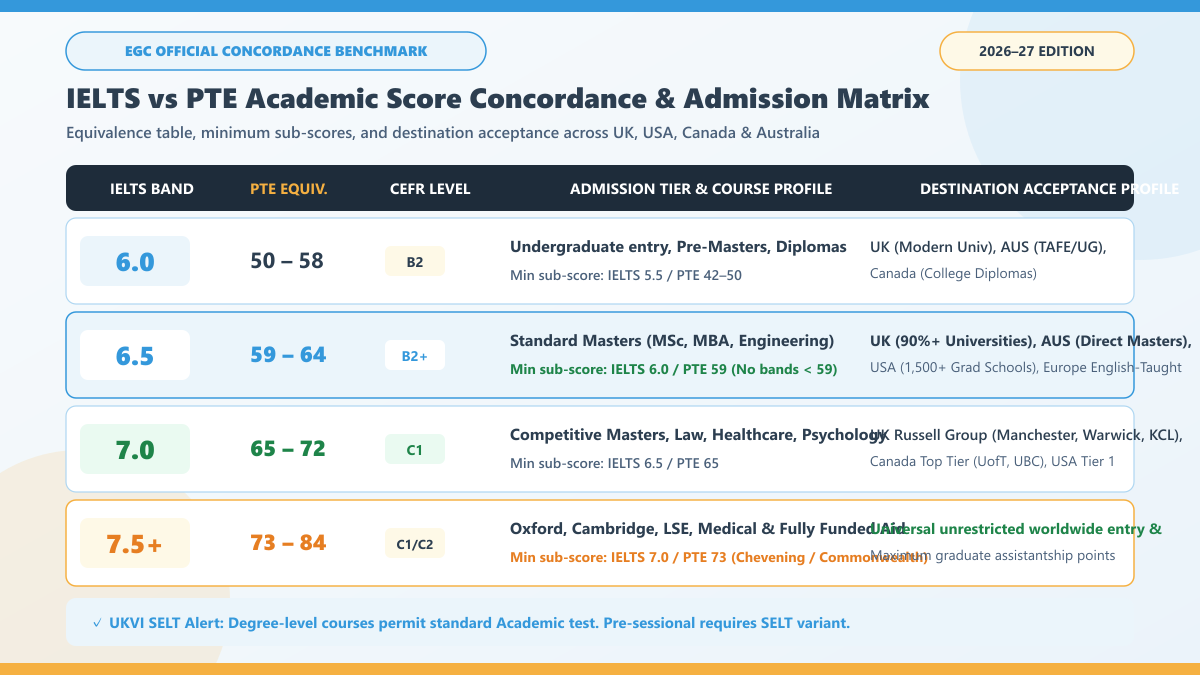
Figure 1: Official IELTS vs PTE Academic Score Concordance & Admission Matrix across UK, USA, Canada, and Australia (2026–27 Intake).
1. The Farhan Kabir Case: Breaking the Band 5.5 Writing Ceiling
Farhan Kabir, an exceptional computer science graduate from BUET with a 3.85 CGPA, was holding conditional offer letters for an MSc in Advanced Computing from both Imperial College London and the University of Manchester. Both universities required an overall IELTS score of 7.0 with a minimum of 6.5 in all sub-bands.
Farhan sat for the IELTS Academic exam twice at British Council test centers in Dhaka. His results revealed an agonizing pattern:
- Attempt 1: Listening: 8.5 | Reading: 8.0 | Speaking: 7.0 | Writing: 5.5 (Overall: 7.5)
- Attempt 2: Listening: 8.5 | Reading: 8.5 | Speaking: 7.5 | Writing: 5.5 (Overall: 7.5)
Despite achieving near-native scores in receptive skills, human examiners repeatedly penalised his writing style, leaving his unconditional CAS blocked just five weeks before the September intake deadline.
Farhan visited Excellence Global Consultancy’s Mirpur Hub. Our academic assessment team conducted an immediate diagnostic audit:
- Cognitive Profile Analysis: Farhan possessed rapid analytical typing and sharp auditory recall, but struggled with human examiner subjectivity regarding academic cohesion and essay rhetorical flair.
- Strategic Pivot to PTE Academic: Because Pearson VUE uses automated machine scoring based on structural keywords, acoustic oral fluency, and grammar syntax rather than stylistic impression, we transitioned Farhan to PTE Academic.
- Targeted 14-Day Protocol: We trained Farhan on Pearson’s automated scoring rubrics—focusing on Read Aloud, Repeat Sentence, Describe Image, and the 20-minute Write Essay module.
Two weeks later, Farhan sat for PTE Academic at the Pearson VUE center in Dhanmondi. Within 36 hours, his score report arrived: Overall 74 (Listening: 78, Reading: 75, Speaking: 72, Writing: 71)—the precise equivalent of an IELTS 7.5 with no band below 7.0. Manchester issued his unconditional offer in 48 hours, and his UKVI CAS was generated that same week.
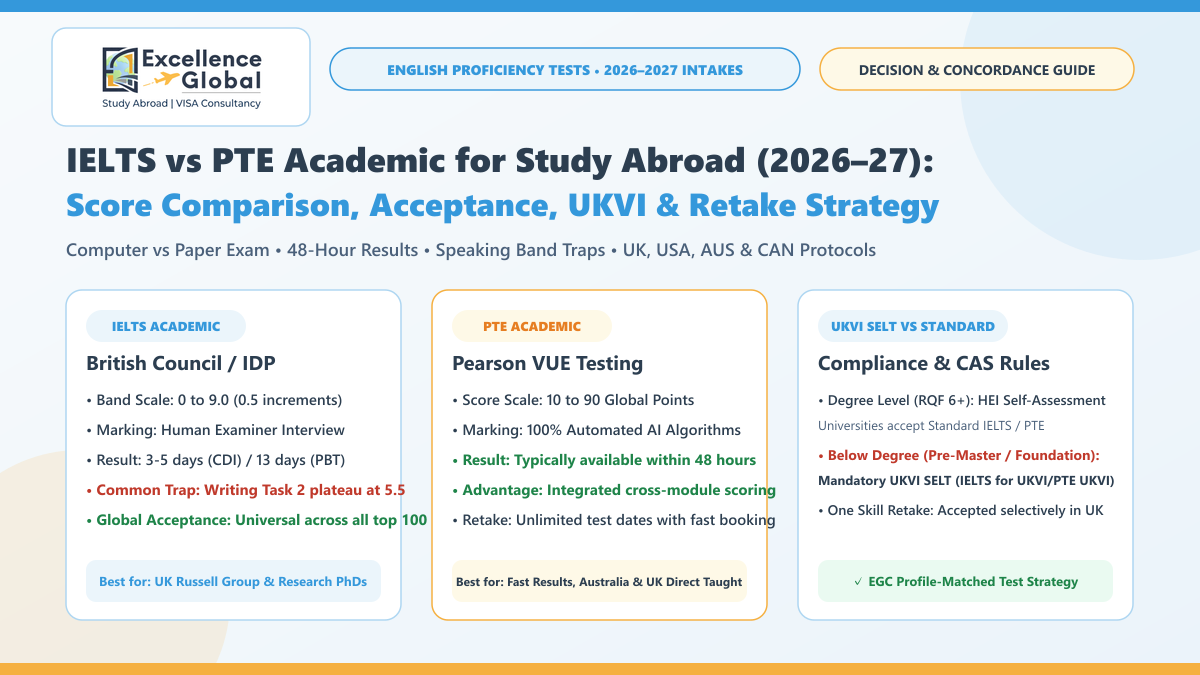
2. Core Structural Differences: Human vs Automated AI Scoring
Understanding how your responses are evaluated is crucial when selecting an English proficiency test:
3. Score Concordance Matrix: IELTS Bands vs PTE Points
To accurately gauge your target admission requirement, refer to this verified concordance mapping used by global admissions committees:
- IELTS Band 6.0 $leftrightarrow$ PTE Academic 50–58: Minimum requirement for standard undergraduate diplomas, Foundation programmes, and selective regional university courses in Australia and the UK.
- IELTS Band 6.5 $leftrightarrow$ PTE Academic 59–64: The global standard requirement for 90%+ of taught Master’s programmes (MSc, MBA, MA) across the UK, Australia, New Zealand, and European public universities. Requires no sub-score below 59.
- IELTS Band 7.0 $leftrightarrow$ PTE Academic 65–72: High-tier benchmark required by UK Russell Group universities (Manchester, Edinburgh, Warwick, KCL), prestigious Canadian graduate faculties, Clinical Medicine, Law, and Nursing programmes.
- IELTS Band 7.5+ $leftrightarrow$ PTE Academic 73–84+: Elite entry tier required by Oxford, Cambridge, Imperial, LSE, and competitive scholarship schemes such as Commonwealth and Chevening.
4. UKVI SELT Compliance: When Do You Need a SELT?
A frequent point of confusion among Bangladeshi students is the distinction between a Standard Academic Test and a UKVI SELT (Secure English Language Test):
UKVI Regulatory Framework for Student Visas:
Under UK Home Office Appendix Student rules, the requirement for a SELT test depends strictly on your academic course level:
- Degree Level and Above (RQF Level 6, 7 & 8 — Bachelor’s, Master’s, PhD): UK Higher Education Institutions (HEIs) with Student Sponsor status possess Statutory Assessment Authority. They can assess English language proficiency using their own criteria. Therefore, standard IELTS Academic or standard PTE Academic is 100% valid for CAS issuance.
- Below Degree Level (RQF Level 3, 4 & 5 — Foundation, International Year One, Pre-Sessional English): If your CAS is issued for a course below degree level, UKVI mandates a government-approved SELT. You must take either IELTS for UKVI or PTE Academic UKVI. Taking a standard non-SELT test will result in an immediate visa rejection.
5. Global University Acceptance: UK, USA, Canada & Australia
Before committing to a test date, verify acceptance across your primary destination markets:
- United Kingdom: Universally accepted. All 24 Russell Group institutions accept both IELTS and PTE Academic for direct post-graduate entry.
- Australia: Australia is PTE’s strongest market. The Department of Home Affairs and 100% of Australian universities (including the Group of Eight) accept PTE Academic equally with IELTS.
- Canada: Under Canada’s SDS and standard study permit channels, IRCC accepts PTE Academic alongside IELTS Academic. Leading Canadian institutions (Toronto, McGill, UBC, Waterloo) accept PTE with minimum benchmarks of 65+.
- United States: While IELTS and TOEFL remain historic staples, over 1,500 US colleges and graduate faculties (including Harvard, Yale, Columbia, and NYU) now accept PTE Academic for admissions.
- Europe (Germany, Finland, Sweden, Netherlands): English-taught Bachelor’s and Master’s programmes across the Schengen Area accept both IELTS Academic (typically 6.5) and PTE Academic (typically 62–65).
6. The EGC Decision Framework: Which Test Should You Take?
At Excellence Global Consultancy, we evaluate each student’s profile before recommending a test route. Use this diagnostic matrix to make your decision:
Choose IELTS Academic If:
- You express ideas more naturally in an interactive, human conversation rather than speaking into a computer microphone.
- You get easily distracted or anxious when other test-takers speak aloud simultaneously in the same room.
- You are targeting elite academic research scholarships (e.g., Chevening, Commonwealth) where an IELTS TRF is traditionally customary.
- You prefer paper-based highlighting and annotating during long reading passages.
Choose PTE Academic If:
- You have repeatedly scored 5.5 or 6.0 in IELTS Writing and feel trapped by human examiner subjectivity.
- You have fast computer typing skills and clear, consistent oral pronunciation.
- You have tight application deadlines and need official certified scores delivered within 48 hours.
- You are applying primarily to universities in Australia, New Zealand, or UK taught Master’s programmes.
7. Registration Fees & Test Center Logistics in Bangladesh
Both exams have established official testing facilities across Dhaka and regional centers:
- IELTS Test Fee (2026): Approximately BDT 23,500 to 25,000 (varying with exchange rates for standard Academic or UKVI). Bookings are conducted online via British Council Bangladesh or IDP Bangladesh with test venues in Dhaka (Gulshan, Dhanmondi, Uttara), Chittagong, and Sylhet.
- PTE Academic Fee (2026): Approximately USD 215 to 225 (payable via international dual-currency credit card or verified local banking partner). Test centers are located in Dhaka at certified Pearson Professional Centers and third-party authorized testing facilities in Banani and Dhanmondi.
Unsure Whether IELTS or PTE Fits Your Target University?
Don’t risk test registration fees or visa delays on guesswork. Visit Excellence Global Consultancy for a comprehensive English Test Diagnostic Session. We analyze your academic background, test history, and target course requirements to chart your optimal pathway.
Book Your English Diagnostic Consultation or explore our Full Admissions & Visa Services.
Leave a Reply