
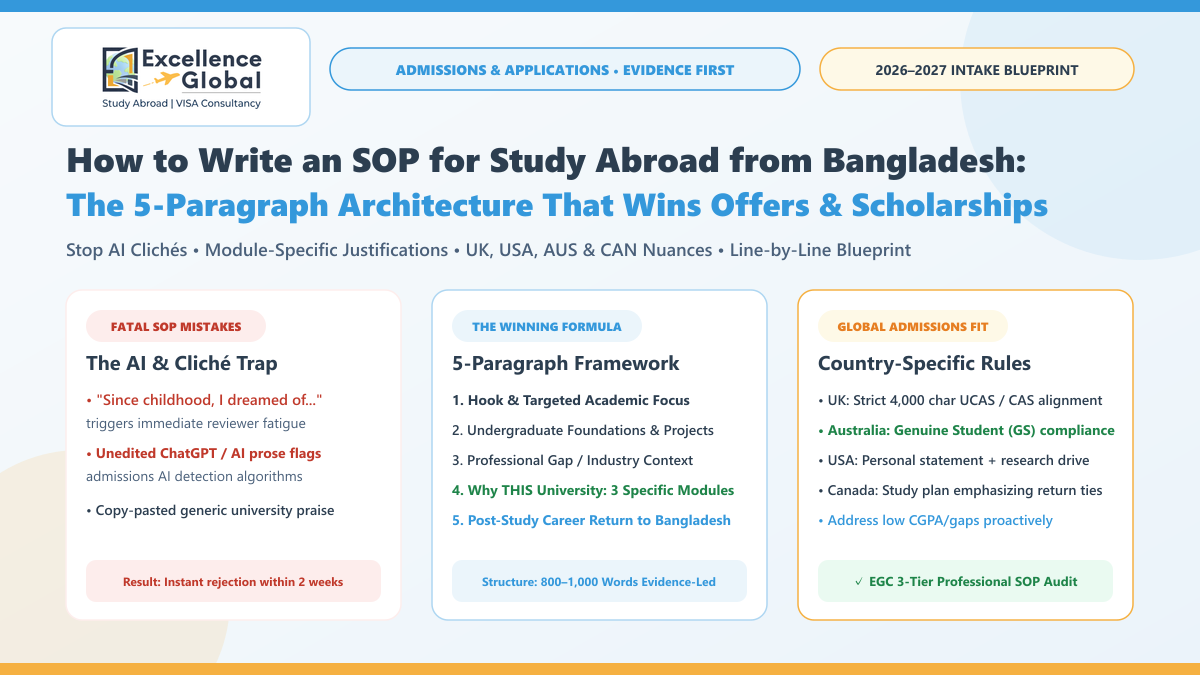
In international university admissions for 2026–2027, your Statement of Purpose (SOP) is the single piece of documentation where you speak directly to the professors deciding your future. Transcripts show your past grades; the SOP demonstrates your intellectual curiosity, research focus, and career vision. Yet, every admissions cycle, thousands of high-achieving Bangladeshi graduates receive unexpected rejection letters from UK Russell Group, US Tier-1, and Canadian U15 universities. The reason is rarely academic incompetence—it is the fatal reliance on AI-generated boilerplate text, childhood dream clichés, and lack of course-specific evidence. Here is the definitive, evidence-backed 5-paragraph SOP architecture designed to win direct offers and competitive departmental scholarships.
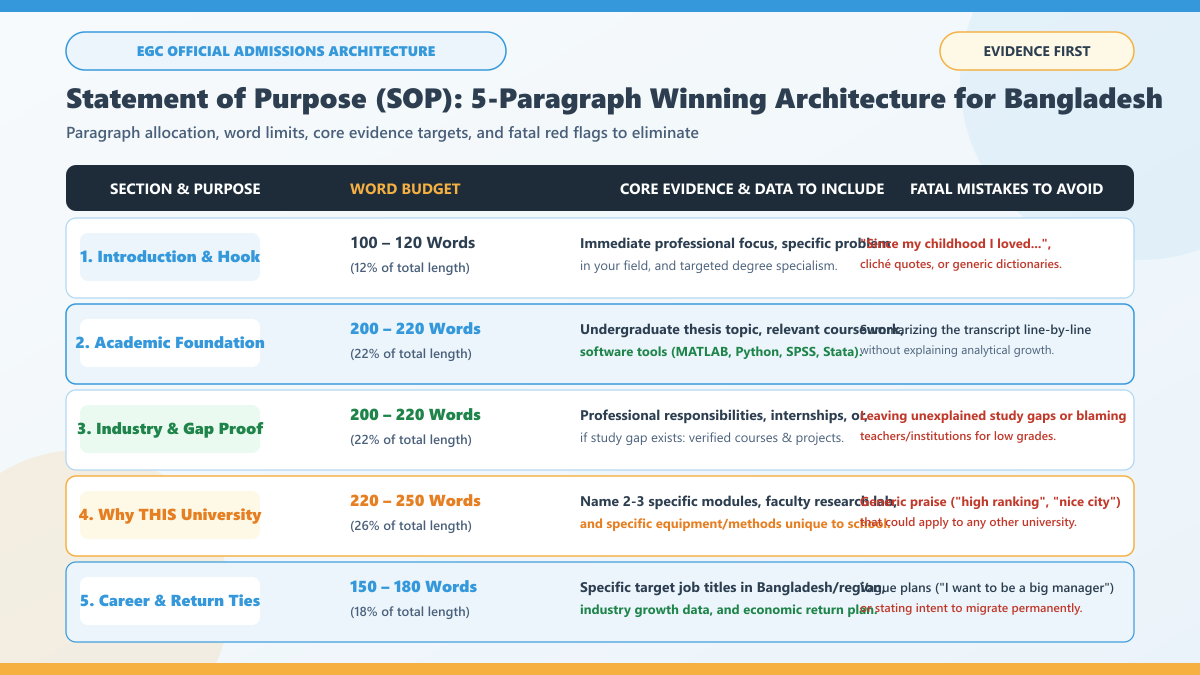
Figure 1: Statement of Purpose (SOP) 5-Paragraph Winning Architecture, Word Budgets, and Evidence Criteria (2026–27 Edition).
1. The Tanzim Rahman Case: Why AI and Childhood Clichés Get Rejected
Tanzim Rahman, an Electrical & Electronic Engineering graduate from IUB with an impressive 3.65 CGPA and two conference publications, applied to five leading UK universities for an MSc in Renewable Energy Engineering in October 2025. Confident in his credentials, Tanzim generated his SOP using ChatGPT, guided by a popular agency template.
His essay opened with the classic trope:
“Ever since I dismantled an old radio at age seven, electrical engineering has been my soul’s true calling. Driven by an insatiable curiosity for the miracles of technology, I have always harboured a burning desire to study at your esteemed institution, renowned for its illustrious campus and world-class faculty…”
Within four weeks, four universities—including Sheffield, Southampton, and Queen Mary University of London (QMUL)—issued unconditional rejections. The feedback from Sheffield’s admissions tutor was succinct: “The applicant’s statement lacks course-specific academic focus, relies on non-authentic generalizations, and does not articulate how our specific curriculum matches their prior research experience.”
Tanzim came to Excellence Global Consultancy. Our admissions advisory division executed an urgent structural rescue:
- Dismantling AI Clichés: We eliminated all childhood anecdotes, hollow flattery, and AI-generated buzzwords (“insatiable curiosity”, “illustrious institution”).
- Centering Real Industrial Experience: We grounded his narrative in his 6-month undergraduate internship at an industrial solar microgrid facility in Gazipur, detailing the exact power inverter efficiency loss challenges he encountered.
- Curriculum-Specific Alignment: We researched QMUL’s and Sheffield’s specific course modules, explicitly referencing QMUL’s “Advanced Power Electronic Converters” module and Professor X’s grid-stability research.
- Bilateral Career Return: We connected the degree to Bangladesh’s national Mujib Climate Prosperity Plan and the growing requirement for grid-integration engineers at PGCB and private energy developers.
Upon re-submitting with a customized, evidence-based SOP, QMUL granted him an immediate unconditional offer with a £4,000 International Science & Engineering Excellence Scholarship.
2. The 4 Fatal SOP Clichés That Admissions Tutors Immediately Flag
Admissions tutors review thousands of international statements every month. When they encounter these four common patterns, applications are rapidly deprioritized:
- Cliché 1: The “Childhood Epiphany” Narrative: Opening with “Since my childhood, I always wanted to be a doctor/engineer/marketer” sounds immature for postgraduate study. Admissions committees care about your adult, university-level intellectual decisions.
- Cliché 2: The “Web-Scraped Flattery” Paragraph: Writing “Your university is ranked 82nd in the QS World Rankings and boasts a beautiful library” tells professors nothing about you. They already know their ranking; they want to know why their specific laboratory or syllabus fits your career.
- Cliché 3: The “Transcript in Sentence Form”: Simply re-writing your grades (“In my first semester I took Calculus and got an A, then in my second semester I took Algorithms…”) wastes valuable word count. Admissions tutors already have your official transcript.
- Cliché 4: Unedited AI Vocabulary: Words like “delve”, “tapestry”, “beacon of knowledge”, “pivotal milestone”, “in conclusion” are dead giveaways of generative AI tools. Tutors immediately penalize AI prose under authenticity criteria.
3. The Winning 5-Paragraph SOP Architecture
To ensure structural clarity and maintain reviewer engagement, structure your 800 to 1,000-word SOP across five distinct paragraphs:
4. Country-Specific SOP Nuances: UK vs USA vs Australia vs Canada
Each destination country evaluates your statement through a distinct lens:
United Kingdom (Strictly Academic)
UK admissions tutors look for 80% academic and 20% professional/extracurricular focus. Under the Points-Based Student Route, universities also cross-examine your SOP during mandatory Pre-CAS credibility interviews. Keep tone formal and course-centric.
Australia (Genuine Student Focus)
Under the new Genuine Student (GS) assessment for Subclass 500 visas, you must answer specific structured questions: why you cannot study in Bangladesh, why you chose Australia over UK/US, your realistic starting salary upon return, and immigration compliance.
United States (Holistic & Narrative)
US graduate schools welcome personal storytelling: what intellectual experiences shaped your philosophy, how you handled academic setbacks, and how you will enrich campus diversity. For PhDs, faculty research alignment is 100% paramount.
Canada (Study Plan & Home Ties)
In addition to university review, IRCC visa officers examine your “Letter of Explanation / Study Plan”. You must prove that the program represents logical academic progression and that your return to Bangladesh offers superior financial ROI.
5. Proactively Defending Low CGPA, Backlogs, or Study Gaps
If your profile has blemishes, address them in Paragraph 3 with confidence and evidence:
- CGPA Deficit (Below 3.00): Highlight strong performance in major core subjects (e.g., “While my cumulative CGPA was 2.85 due to early foundational mathematics adjustments, my 300-level and 400-level major coursework in Machine Learning averaged 3.60”).
- Study Gap (1 to 5 Years): Present the gap as productive professional seasoning. List full-time roles, freelance projects, professional certifications, or family care responsibilities with verifiable dates and employer letterheads.
Get Your SOP Audited by EGC Admissions Specialists
At Excellence Global Consultancy, we don’t rewrite your story—we polish your authentic voice. Our editorial specialists review your SOP line-by-line against university rubrics, eliminate AI and grammatical flags, and ensure bulletproof compliance for admissions and visa interviews.
Book Your SOP Review Consultation or explore our Comprehensive Service Packages.
Leave a Reply