
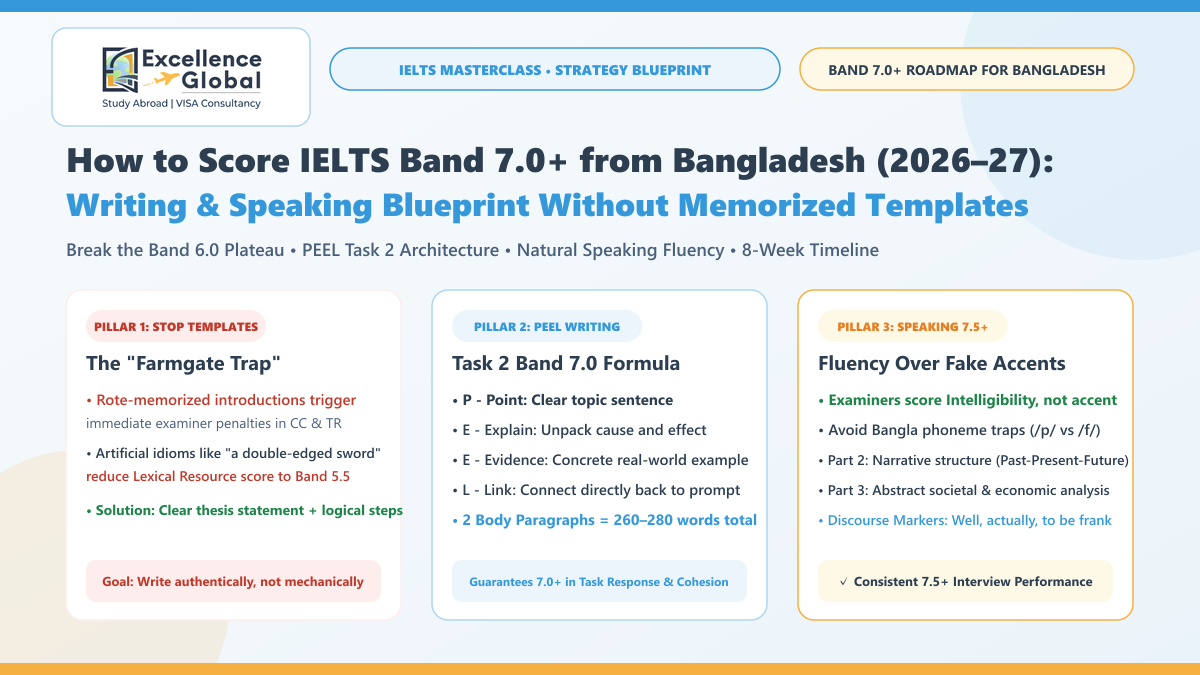
Every year in Bangladesh, tens of thousands of university graduates and HSC candidates enrol in commercial coaching centres across Dhaka, Chittagong, and Sylhet, hoping to unlock an IELTS Band 7.0 or 7.5 for international admissions and scholarships. Yet, exam statistics consistently show that a staggering majority remain plateaued at Band 6.0 or 6.5. The reason is rarely a lack of English ability; it is the destructive reliance on rigid, memorized essay templates and artificial speaking idioms. Here is the evidence-based master blueprint to achieving an authentic Band 7.0+ score—grounded in official British Council/IDP assessment rubrics and practical application strategies for Bangladeshi candidates.
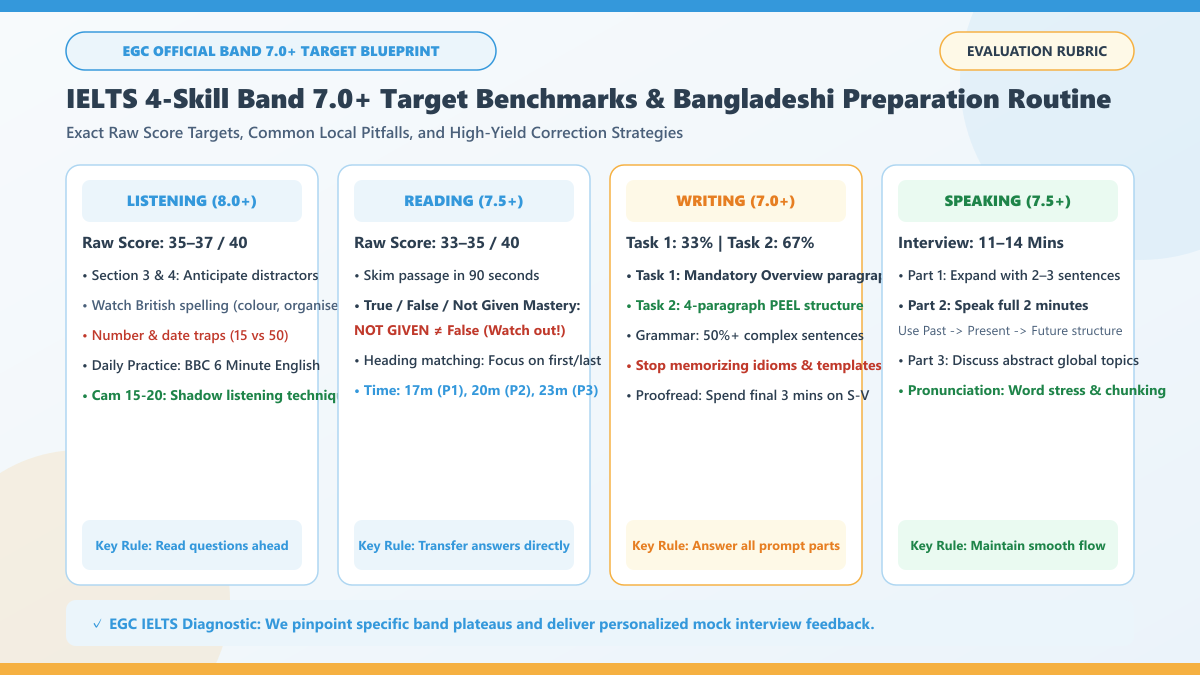
Figure 2: 4-Skill IELTS Band 7.0+ Target Benchmarks, Assessment Criteria, and Weekly Preparation Routine (2026–27 Edition).
1. The Anika Tabassum Case Study: Escaping the “Farmgate Trap”
Anika Tabassum graduated in Finance from North South University with a 3.40 CGPA. Her ambition was to study for an MSc in International Business at the University of Leeds, which required a minimum overall IELTS band of 7.0 with no skill below 6.5. Over the course of nine months, Anika took the IELTS exam three times:
- Attempt 1 (Jan 2026): L: 7.5 | R: 7.0 | S: 6.0 | W: 5.5 (Overall: 6.5)
- Attempt 2 (April 2026): L: 8.0 | R: 7.5 | S: 6.0 | W: 6.0 (Overall: 7.0 — Missed sub-score)
- Attempt 3 (June 2026): L: 8.0 | R: 7.0 | S: 6.0 | W: 5.5 (Overall: 6.5 — Reverted)
Frustrated and facing a looming Leeds application deadline, Anika sought guidance from Excellence Global Consultancy. During our initial diagnostic review, we asked Anika to write a timed Task 2 essay. The root cause of her score plateau was immediately glaring: she had memorized over fifty boilerplate paragraphs from popular coaching guidebooks in Farmgate. Her opening sentence read:
“Since the dawn of human civilization, this contentious issue has sparked heated debate across the globe. While proponents vehemently argue that X is beneficial, opponents maintain that it is a double-edged sword…”
IELTS examiners read hundreds of essays weekly. When they encounter these prefabricated, robotic introductions, they immediately identify non-authentic writing. Anika was being systematically downgraded under Task Response (for failing to provide a focused, context-specific thesis) and Lexical Resource (for cramming unnatural, archaic idioms).
EGC’s IELTS coaching division executed an immediate reset:
- Stripping Memorized Boilerplate: We dismantled her memorized templates and taught her the PEEL paragraph structure (Point, Explain, Evidence, Link).
- Speaking Oral Realignment: We stopped her from attempting an artificial pseudo-British accent, training her instead on natural discourse markers (“To be completely honest…”, “From a macroeconomic perspective…”) and syllable stress.
- Targeted Error Logging: We created an active error journal targeting subject-verb agreement errors common among Bengali speakers (e.g., singular/plural countability).
Four weeks later, Anika sat for the Computer-Delivered IELTS at IDP Gulshan. Her official Test Report Form arrived: Listening: 8.5 | Reading: 8.0 | Speaking: 7.5 | Writing: 7.0 — Overall Band 7.5. She secured unconditional admission to Leeds and was awarded a £5,000 Dean’s Excellence Scholarship.
2. The 4 Assessment Criteria: What Examiners Actually Score
To score Band 7.0+, you must dissect the official IELTS Public Band Descriptors. Each skill is marked across four distinct 25% weightings:
3. The PEEL Paragraph Architecture for Writing Task 2
To eliminate the fear of running out of ideas or writing disorganized essays, structure your two body paragraphs using the PEEL framework:
The 4-Step PEEL Formula (Approx. 90–100 words per body paragraph):
- P — Point (Sentence 1): State your central argument directly. (e.g., “One major economic consequence of automation in manufacturing is the displacement of low-skilled labourers.”)
- E — Explain (Sentences 2–3): Unpack the underlying mechanism. Explain why or how this occurs. (e.g., “When enterprises implement automated assembly algorithms, manual tasks are executed with greater precision and lower overhead, rendering traditional assembly line roles redundant.”)
- E — Evidence / Example (Sentence 4): Provide a concrete, plausible real-world illustration. (e.g., “For instance, recent industrial transitions in Southeast Asian automotive hubs demonstrated that factory digitisation decreased manual employment by nearly thirty percent over a five-year period.”)
- L — Link (Sentence 5): Reconnect your point back to the overall prompt question. (e.g., “Consequently, without targeted state reskilling initiatives, technological advancement can exacerbate domestic unemployment.”)
4. Speaking Band 7.5+: Natural Intelligibility Over Accents
The single biggest myth among Bangladeshi IELTS candidates is that you must mimic a British or American accent to score Band 7.0 or higher. This is completely false. Examiners look for Intelligibility and Natural Fluency:
- First-Language Phonetic Traps: In Bengali phonology, the /f/ and /p/ sounds are frequently conflated, as are /v/ and /b/. Practice auditory contrast pairs (fan vs pan, very vs berry) to avoid phonemic confusion.
- Part 2 Long Turn (Cue Card): Never memorize a script for topics like “a memorable journey” or “a book you read.” Instead, organize your 2-minute speech chronologically using the Past $
ightarrow$ Present $
ightarrow$ Future framework. This naturally showcases a wide variety of tenses and complex sentence structures without awkward pauses. - Part 3 Discussion Mastery: Part 3 is where Band 7.0 is earned or lost. Examiners ask abstract, societal questions (e.g., “How does social media influence national cultural traditions?”). Move away from personal anecdotes (“I like Facebook…”) and analyze the issue objectively from sociological, economic, and generational perspectives.
5. Listening & Reading 8.0+: Raw Score Arithmetic
Receptive skills (Listening and Reading) are mathematically predictable. Scoring Band 8.0+ in both provides a massive mathematical cushion, ensuring your overall band reaches 7.5 even if Writing is graded at 6.5:
- Academic Listening (Target: 35/40 Correct): Train specifically on Section 3 (academic dialogues with multiple speakers) and Section 4 (monologue lecture). Learn to detect verbal distractors—where a speaker states an answer and immediately corrects themselves (e.g., “We planned to depart at 4:30, but the storm delayed us until 5:15”).
- Academic Reading (Target: 33–35/40 Correct): Master the difference between FALSE (the passage directly contradicts the statement) and NOT GIVEN (the topic is mentioned, but the specific fact is neither confirmed nor refuted). Budget your time strictly: 17 mins for Passage 1, 20 mins for Passage 2, and 23 mins for Passage 3.
6. The 8-Week Evidence-Based Preparation Routine
Consistency beats cramming. Follow this structured 8-week timeline designed specifically for candidates working or studying in Bangladesh:
- Weeks 1–2 (Diagnostic & Skill Foundation): Complete Cambridge Official IELTS Academic Practice Books (Volumes 16 to 19) tests under un-timed conditions. Identify which question types (Headings, Matching Features, Map Labeling) cause consistent errors.
- Weeks 3–4 (Structural Writing & PEEL Mastery): Write 3 Task 1 summaries and 3 Task 2 essays weekly. Focus strictly on achieving 100% clarity in Task Response and eliminating non-authentic vocabulary. Have essays evaluated against official band descriptors.
- Weeks 5–6 (Speaking Fluency & Timed Simulation): Record yourself answering Cambridge speaking prompts daily. Listen back for hesitation markers, repetition, and phonetic clarity. Take full-length Listening and Reading tests strictly within the 60-minute time cap.
- Weeks 7–8 (Full Mock Tests & Tapering): Sit for 4 full-length, uninterrupted mock exams (Listening, Reading, Writing back-to-back). Analyze remaining error trends in your active error journal and rest 48 hours before test day.
Ready to Break the Band 6.0 Plateau?
At Excellence Global Consultancy, we don’t teach shortcuts or generic coaching templates. Our certified language strategists provide comprehensive writing evaluations and 1-on-1 mock speaking audits to ensure you achieve your target Band 7.0+ on your very next attempt.
Book an IELTS Assessment Session or explore our Global Scholarship Portal.
Leave a Reply