
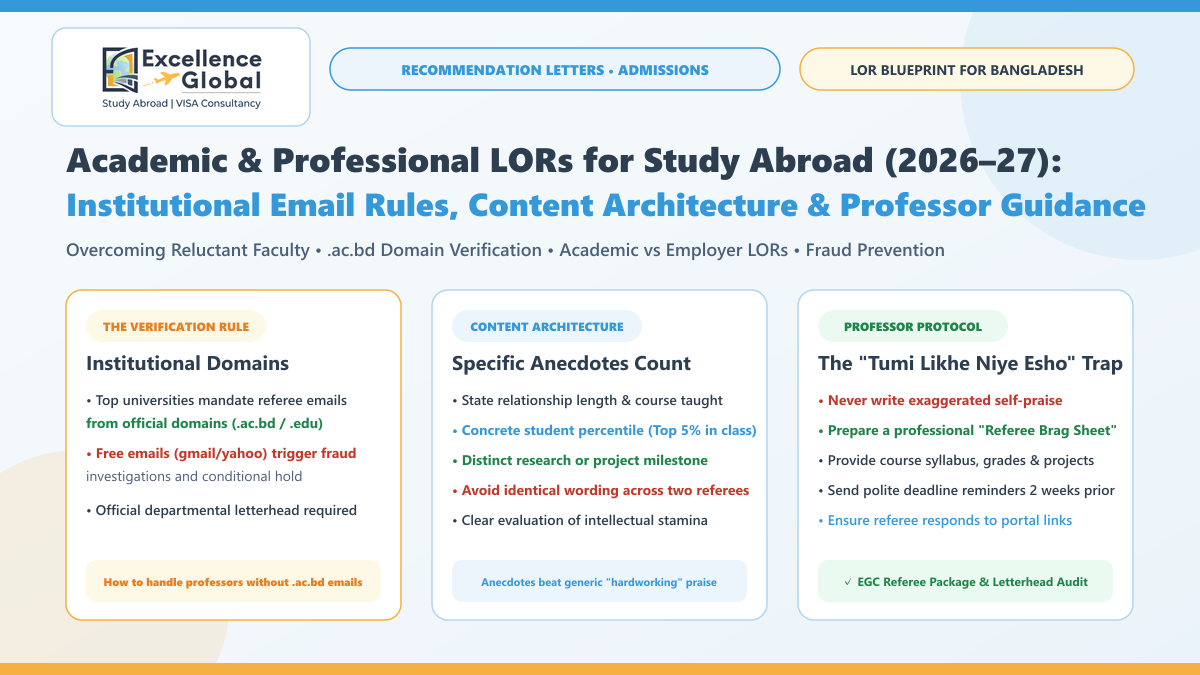
While your Statement of Purpose represents what you say about yourself, your Letters of Recommendation (LOR) represent what established authorities say about your intellect, character, and research endurance. In postgraduate admissions across Canada, the USA, the UK, and Europe, two glowing letters from respected faculty can turn a borderline CGPA into a fully funded graduate assistantship. However, Bangladeshi applicants face unique institutional hurdles: professors without official institutional email domains, the pervasive “tumi likhe niye esho” (write it yourself) phenomenon, and suspicious duplicate templates that trigger admissions fraud alerts. Here is the definitive guide to securing bulletproof, credible recommendation letters from Bangladesh.
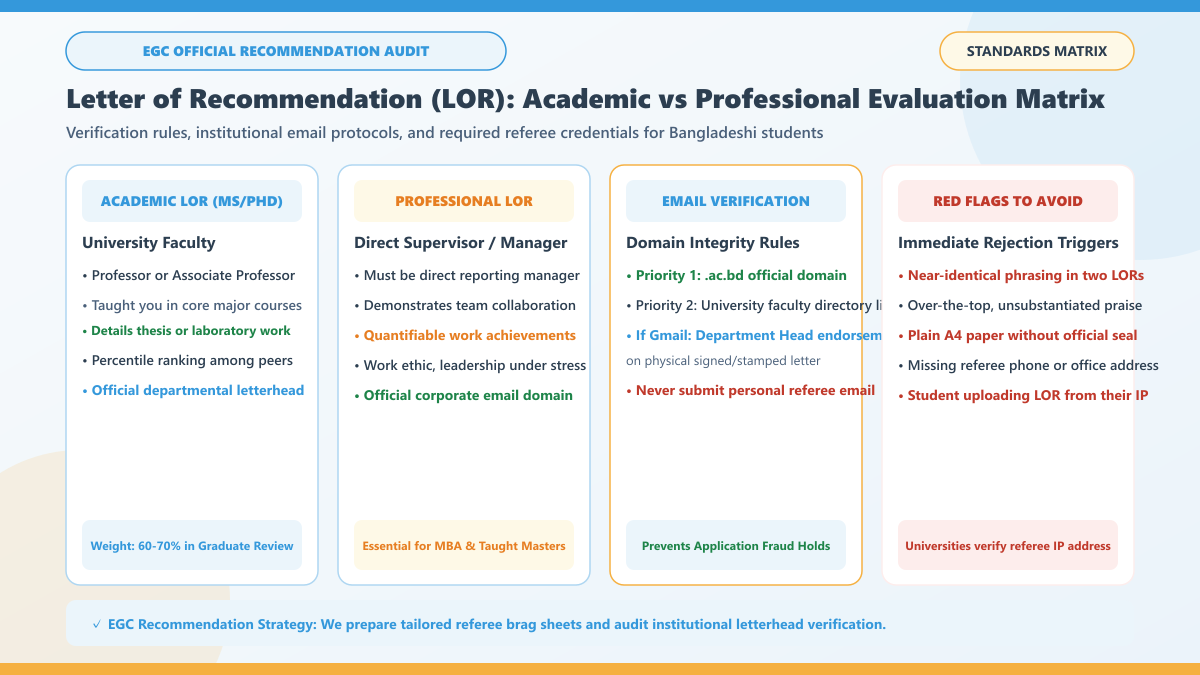
Figure 2: Letter of Recommendation (LOR) Verification Standards, Institutional Email Protocols, and Red Flags Matrix (2026–27 Edition).
1. The Nadia Sultana Case: When Free Email LORs Trigger Application Holds
Nadia Sultana graduated from the Department of Botany at the University of Chittagong with a strong 3.58 CGPA and completed her undergraduate thesis on medicinal plant phytochemistry. In early 2026, she submitted applications for an MSc in Plant Biology to three premier Canadian institutions: the University of Alberta, University of British Columbia (UBC), and McMaster University.
Four weeks later, her application portal at the University of Alberta was placed on Administrative Verification Hold. The graduate admissions department sent an email requesting formal verification: both of Nadia’s academic referees—respected professors at Chittagong University—had submitted recommendations from free @yahoo.com and @gmail.com accounts. Furthermore, the phrasing of both letters featured identical introductory sentences, and the submission IP addresses matched Nadia’s home broadband connection in Nasirabad, Chittagong.
The Canadian admissions committee suspected that Nadia had written and submitted both letters herself, creating a major ethical hurdle that threatened her international academic future.
Nadia sought assistance from Excellence Global Consultancy’s admissions audit division. We initiated immediate damage control:
- Institutional Validation Protocol: We coordinated with the Department of Botany at Chittagong University to retrieve official
.ac.bdfaculty email addresses from the central IT cell. - Physical Departmental Letterhead Endorsement: For the senior professor who preferred his established Yahoo account, we prepared an official recommendation package printed on heavy departmental letterhead paper, bearing the university seal, landline phone number, and a direct URL to the official faculty registry page.
- Differentiated Refinement: We audited both letters to reflect completely distinct perspectives: one professor focused exclusively on her laboratory titration skills and scientific methodology; the second evaluated her seminar presentations, academic curiosity, and peer leadership.
- Formal Explanatory Memo: We submitted an official institutional explanatory memorandum from the Chairman of the Department directly to Alberta’s graduate admissions office.
The administrative hold was lifted within nine days. In April 2026, Nadia received her unconditional offer letter from the University of Alberta along with a $17,500 Graduate Research Assistantship (GRA).
2. The Institutional Email Imperative: Why Domains Matter
Modern graduate admissions systems (e.g., Slate, Apply@UT, Embark) evaluate referee emails using automated fraud algorithms:
3. The “Tumi Likhe Niye Esho” Dilemma: How to Draft Professionally
In Bangladesh, it is widespread practice for busy professors to say: “Tumi ekta draft likhe niye asho, ami dekhe sign kore dibo.” If your referee requests a preliminary draft, avoid writing exaggerated, generic flattery. Instead, follow this evidence-based structure:
The 4-Paragraph LOR Architecture:
- Context & Capacity (Paragraph 1): State clearly how long and in what capacity the professor has known you (e.g., “I have known X for over three years in my capacity as Professor of Computer Science at BUET, having taught him in two advanced algorithms courses and supervised his senior capstone project”).
- Quantitative Academic Standing (Paragraph 2): Provide a concrete benchmark ranking among your cohort (e.g., “Among the 65 students in the graduating cohort, X ranked within the top 5% in mathematical rigor and analytical assignment execution”).
- Specific Qualitative Anecdote (Paragraph 3): Describe a tangible moment of scientific or scholarly persistence (e.g., a challenging lab experiment where you identified an anomaly, debugging an algorithm over the weekend, or presenting a conference poster).
- Postgraduate Endorsement (Paragraph 4): A strong, unequivocal recommendation for independent research and graduate school readiness, signed with full academic titles and contact numbers.
4. Academic LOR vs Professional Employer LOR
Understand which type of recommendation your target course prioritizes:
- Academic LOR (Research MS, PhD, Direct Masters): Must come from full-time university faculty (Professors, Associate Professors, Assistant Professors). Focuses on intellectual depth, theoretical mastery, research methodology, and writing stamina.
- Professional LOR (MBA, Executive Masters, Management): Must come from your direct reporting manager or team lead at a registered company. Focuses on leadership, deadline management, team collaboration, professional ethics, and commercial problem-solving.
5. Protocol for Approaching Bangladeshi Professors
To ensure a smooth, positive recommendation experience, treat the interaction with professional courtesy:
- Prepare a “Referee Brag Sheet”: Assemble a clean 2-page packet including: your updated Academic CV, official transcript highlighting the courses taken with that professor, your thesis summary, and a list of target universities with deadlines.
- Request 4 to 6 Weeks in Advance: Never approach a professor 48 hours before an application deadline. Give them sufficient time to review and upload documentation.
- Never Upload from Your Own Device: When portal invitation links arrive, bring a laptop to the professor’s office or guide them politely to submit from their own departmental computer. Submitting from your own IP address can trigger automated fraud security systems.
Audit Your Recommendation Portfolio with EGC
Don’t let missing institutional emails or weak recommendation letters hold back your study abroad dreams. Excellence Global Consultancy provides comprehensive referee package preparation, institutional email compliance checks, and letterhead audits to ensure your application stands out.
Book Your Admissions Consultation or explore our Global Scholarship Portal.
Leave a Reply