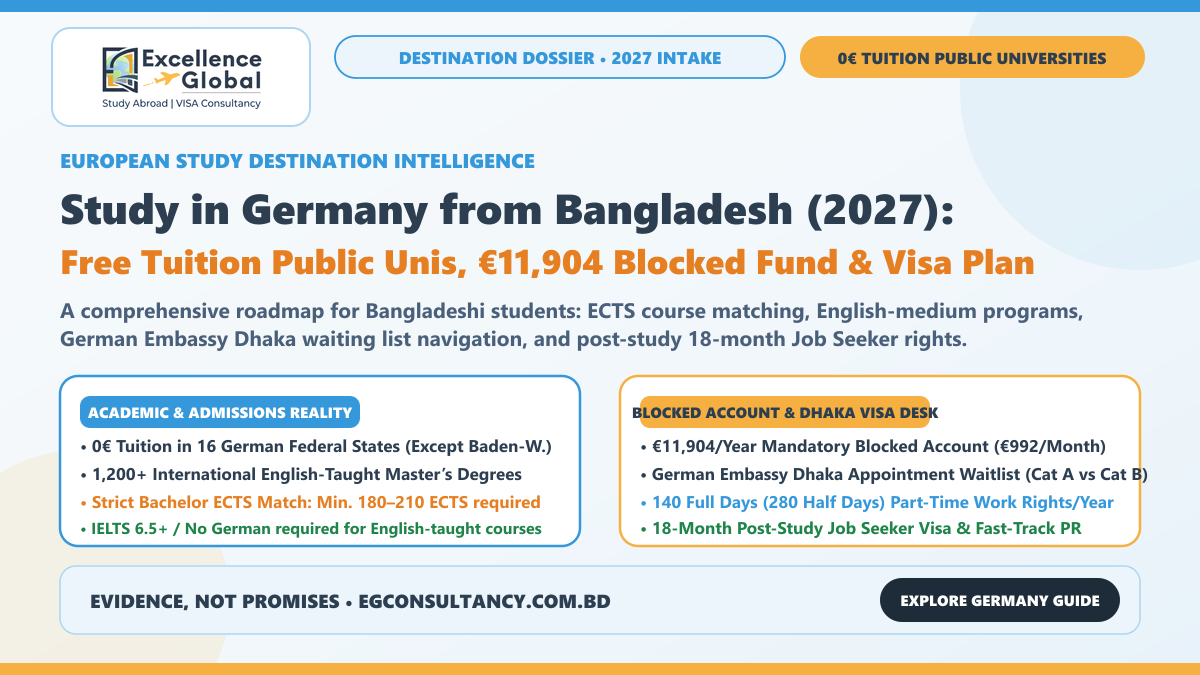
For Bangladeshi graduates navigating rising global tuition fees, currency depreciation, and tighter visa caps across traditional English-speaking destinations, Germany stands as the most compelling academic gateway in Europe. With world-leading engineering, computer science, and business faculties charging 0€ in tuition fees across 15 federal states, the economic proposition is unmatched. However, securing admission and a German national visa (Aufenthaltserlaubnis zum Studium) is governed by rigorous academic credit mathematics, strict Blocked Account thresholds, and meticulous German Embassy Dhaka appointment scheduling. Here is the evidence-backed, step-by-step roadmap to successfully plan your study in Germany from Bangladesh for 2027.
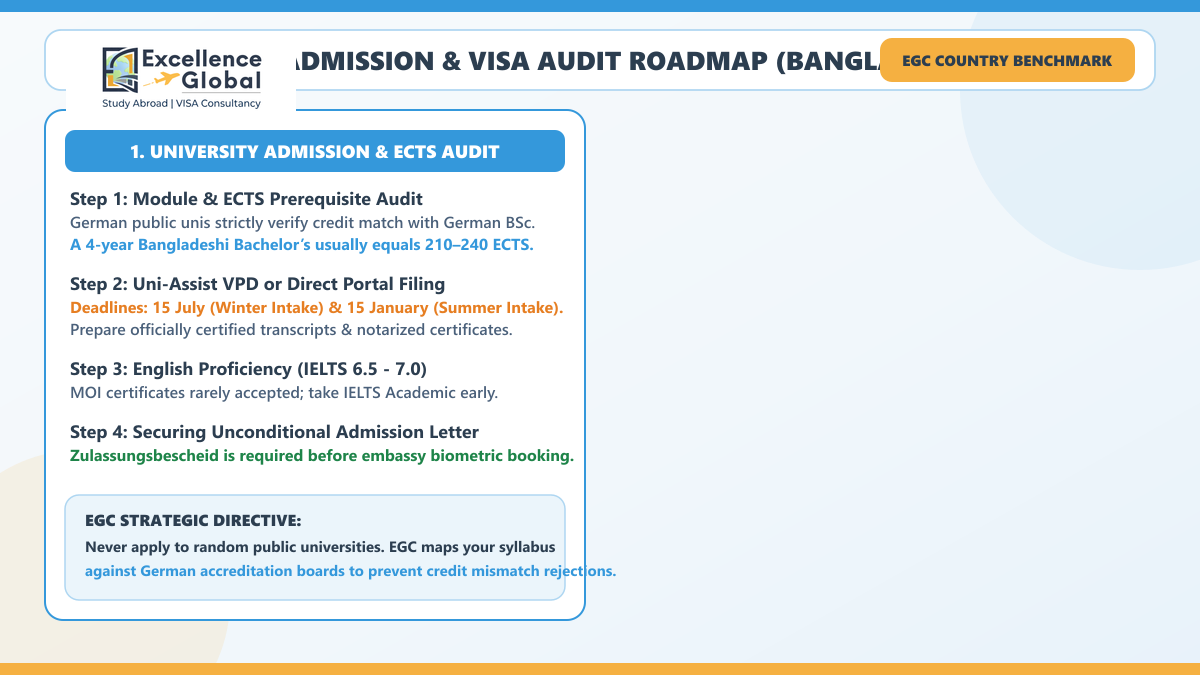
Figure 1: Step-by-Step German Public University Admission Pipeline and Embassy Dhaka Visa Protocol (2027 Intake).
1. The Arif Hossain Case: Why Random TU9 Applications Fail
In November 2025, Arif Hossain, a mechanical engineering graduate from CUET with a 3.42 CGPA and IELTS 7.0, visited Excellence Global Consultancy’s Mirpur Consultation Hub. Arif had spent the preceding six months applying independently through Uni-Assist to prestigious TU9 institutions—including Technical University of Munich (TUM), RWTH Aachen, and TU Berlin—for Master’s in Computational Mechanics and Robotics. To his shock, he received four consecutive rejections despite fulfilling all minimum CGPA and English language benchmarks.
Upon auditing Arif’s university rejection notices, our senior evaluation team identified the exact culprit: ECTS credit mismatch. German Master’s degrees are strictly consecutive (konsekutiv). TUM and RWTH Aachen required exactly 24 ECTS in Finite Element Analysis (FEA) and Advanced Numerical Mathematics. Arif’s Bachelor’s curriculum at CUET provided 16 ECTS in these specialized sub-disciplines. His remaining mathematics credits were distributed across General Engineering Mechanics and Industrial Management—which the German admission committees excluded from the specialized prerequisite count.
EGC immediately restructured Arif’s application matrix:
- We mapped his 148 undergraduate credit hours against the German Anabin database and European Credit Transfer and Accumulation System (ECTS), identifying his surplus strength in Thermodynamics and Fluid Mechanics.
- We shortlisted four tuition-free, high-ranked German public universities—including Friedrich-Alexander University Erlangen-Nürnberg (FAU), University of Siegen, and TU Chemnitz—whose curriculum guidelines exactly mirrored his transcript profile.
- We structured his SOP to directly link his undergraduate thesis with the target laboratory modules, guided his €11,904 blocked account creation with Fintiba, and scheduled his German Embassy Dhaka Category A appointment.
Within 10 weeks, Arif received two unconditional offers from FAU and TU Chemnitz, completed his visa interview without a single document objection, and commenced his studies in Bavaria with zero tuition fees.
2. Tuition-Free Public Universities: The Economic Reality
Unlike the United Kingdom, Australia, or Canada—where international students pay between £16,000 and A$45,000 annually in tuition—Germany’s public higher education system is funded by the state taxpayers. In 15 of Germany’s 16 federal states, tuition fees for undergraduate and consecutive graduate programs remain completely abolished.
The southwestern federal state of Baden-Württemberg (home to universities such as Heidelberg, Stuttgart, Freiburg, and KIT Karlsruhe) charges non-EU international students a tuition fee of €1,500 per semester (€3,000 per academic year). While still a fraction of Western university costs, Bangladeshi students seeking 100% tuition-free education should focus their applications on the other 15 federal states, including Bavaria, North Rhine-Westphalia, Hesse, Lower Saxony, and Saxony.
At tuition-free public universities, students pay only a mandatory administrative semester contribution (Semesterbeitrag), typically ranging from €150 to €380 per semester. This payment covers student union services (Studentenwerk), university registration fees, and in most federal states, an unrestricted regional public transport pass (Semesterticket) allowing free bus, tram, and regional train travel throughout the state.
3. Academic Admissions Mathematics: Anabin & ECTS Conversion
To qualify for a German university, your educational credentials must be officially recognized through the German Standing Conference of the Ministers of Education and Cultural Affairs (KMK) Anabin database.
- Institutional Status (H+): Your Bangladeshi awarding university must possess an H+ status on the Anabin portal. This confirms that your institution is recognized as a full university level in Germany. (Most reputed Bangladeshi public universities and top-tier private universities hold H+ classification).
- Degree Equivalence: A standard 4-year Bangladeshi Bachelor’s degree (minimum 130–150 credit hours) is equivalent to a 3- to 4-year German Bachelor’s degree yielding 180 to 240 ECTS credits. 3-year pass degrees do not qualify for direct Master’s admission and require a 1-year preparatory Studienkolleg or bridge program.
- Consecutive Module Pre-Requisites: German universities do not admit students across radically divergent fields without formal undergraduate preparation. You cannot transition from a Bachelor of Commerce directly into a Data Science Master’s without verifiable undergraduate credits in Linear Algebra, Calculus, and Object-Oriented Programming.
4. Cost Comparison: Germany Public University vs UK & Australia
To appreciate why Germany represents the highest return on investment (ROI) for Bangladeshi middle-class families, examine the realistic first-year capital expenditure comparison:
| Cost Element | Germany (Public Uni) | United Kingdom | Australia |
|---|---|---|---|
| Annual Tuition Fee | 0€ (Free) | £16,000 – £26,000 | A$34,000 – A$48,000 |
| Semester Registration Fee | €300 – €700 / Year | Included in Tuition | Included in Tuition |
| Living Cost / Blocked Fund | €11,904 (Sperrkonto) | £10,827 – £14,130 (Bank Proof) | A$29,710 (Bank Proof) |
| Total Year 1 Liquid Outflow | ~BDT 16 – 18 Lakh | ~BDT 42 – 55 Lakh | ~BDT 52 – 68 Lakh |
| Post-Study Work Visa | 18 Months (Job Seeker) | 24 Months (Graduate Route) | 24 – 36 Months (Subclass 485) |
| Permanent Residency Path | 21–27 Months (EU Blue Card) | Skilled Worker Points (5+ Yrs) | Points-Tested PR (Subclass 189/190) |
5. The 2027 Blocked Account (Sperrkonto) Explained
The German Federal Foreign Office mandates that every non-EU student demonstrate financial self-sufficiency for their initial 12 months. For 2026–2027 academic intakes, this requirement is set at €11,904 per year (€992 per month).
How the Blocked Account functions:
- Opening the Account: You can open an authorized online blocked account through officially certified German fintech partners, including Fintiba, Expatrio, or Coracle. The digital setup takes less than 24 hours from Bangladesh using your valid passport.
- Remitting the Funds: Funds are transferred legally via an Authorized Dealer (AD) Bank in Bangladesh under an official Student File (as regulated by Bangladesh Bank FEPD guidelines).
- Receiving the Sperrbestätigung: Once your transfer lands, the provider issues a formal Blocked Account Confirmation (Sperrbestätigung), which is the sole financial document accepted by the German Embassy Dhaka.
- Disbursement in Germany: Upon arriving in Germany and registering your city address (Anmeldung), you open a local German bank checking account (such as N26, Deutsche Bank, or Sparkasse). The blocked account provider then automatically deposits €992 on the 1st of every month into your checking account to cover rent, health insurance, and groceries.
6. German Embassy Dhaka: Navigating Category A vs Category B
The single greatest operational challenge for Bangladeshi students is securing a visa interview appointment at the German Embassy in Dhaka. The Embassy operates a tiered appointment queue system:
Category A (Fast-Track)
- Applicants with Bachelor CGPA ≥ 3.50 from recognized institutions
- Recipients of official DAAD, Erasmus+, or German state scholarships
- Unconditional direct admission letters to public universities
- Appointment Wait Time: 4 to 10 weeks
Category B (General Queue)
- Applicants with Bachelor CGPA below 3.50
- Holders of conditional admission letters requiring preparatory language courses
- Studienkolleg entrance examination invitees
- Appointment Wait Time: 10 to 14 months
Strategic Directive: If your CGPA is between 3.00 and 3.49, you must plan your German admissions timeline at least 14 months before your intended intake. You cannot wait for university admission letters to arrive before registering on the Embassy appointment queue. Excellence Global helps students structure early queue registration synchronized with Uni-Assist processing to avoid missing enrollment deadlines.
7. Post-Study Work Rights & The Fast-Track EU Blue Card
Germany faces severe skilled labor shortages (Fachkräftemangel) in STEM, mechanical engineering, renewable energy, computer science, medicine, and business analytics. To retain international talent, German immigration law provides unprecedented post-study pathways:
- 18-Month Job Seeker Residence Permit (Section 20(3) AufenthG): Immediately after passing your final Master’s thesis, you are granted an 18-month residence permit. During this period, you hold unrestricted work rights to take any job while interviewing for permanent roles matching your degree.
- EU Blue Card (Blaue Karte EU): When you secure an employment contract offering a gross annual salary of at least €41,041 (for bottleneck professions including STEM and IT) or €45,300 (standard threshold), you transition to an EU Blue Card.
- Permanent Residency (Niederlassungserlaubnis) in 21 Months: Blue Card holders can obtain German permanent residency after only 21 months if they demonstrate German language proficiency at the B1 level (or 27 months with basic A1 German). This is the fastest permanent residency timeline anywhere in the industrialized world.
Plan Your German Winter 2027 Intake with Excellence Global
Navigating German university prerequisites, Uni-Assist VPD certifications, blocked accounts, and Dhaka Embassy appointment scheduling requires absolute precision. At Excellence Global Consultancy, we don’t make speculative promises—we audit your transcripts, map your ECTS modules, and build an airtight, verifiable application dossier.
Book Your Profile Evaluation Session or explore our Dedicated Europe Services Package.
Leave a Reply